AIPMT 2009 question paper with solutions

198 questions · 180 min

Practice the full AIPMT 2009 paper free — every question with a detailed solution, graded instantly. Nothing is saved; log in to take it as a timed mock and track your progress.

Sample questions with solutions

Q1

Which one of the following is the correct matching of three items and their grouping category?

  • A.

    Ilium, ischium, pubis - Coxal bones of pelvic girdle

  • B.

    Actin, myosin, rhodopsin - Muscle proteins

  • C.

    Cytosine, uracil, thiamine - Pyrimidines

  • D.

    Malleus, incus, cochlea - Ear ossicles

Answer: A
  1. Recall the structure of the pelvic girdle.

The pelvic girdle is formed by two innominate bones (hip bones).

  1. Recall what makes up each innominate bone.

Each innominate bone itself consists of three separate bones: the ilium, ischium, and pubis.

  1. Match this with option A.

Since ilium, ischium, and pubis together form the coxal bones of the pelvic girdle, option A is correctly matched.

  1. Check the other options.

Rhodopsin is a visual pigment, not a muscle protein, making option B's grouping incorrect; thiamine is a vitamin, not a pyrimidine (making option C incorrect); and cochlea is part of the inner ear related to hearing, not an ear ossicle like malleus and incus (making option D incorrect).

Hence, the answer is Option A.
Q2

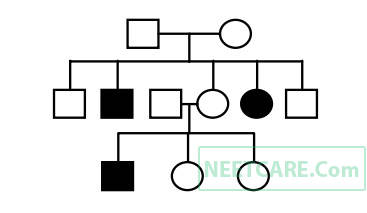
Study the pedigree chart given below :

What does it show ?

  • A.

    Inheritance of a recessive sex-linked disease like haemophilia

  • B.

    Inheritance of a sex-linked inborn error of metabolism like phenylketonuria

  • C.

    The pedigree chart is wrong as this is not possible

  • D.

    Inheritance of a condition like phenylketonuria as an autosomal recessive trait

Answer: D
  1. Recall how to distinguish autosomal from sex-linked inheritance in a pedigree. If an unaffected father and an unaffected (carrier) mother produce affected children of either sex, this points to an autosomal recessive trait, since a sex-linked recessive trait would require the father himself to be affected if his daughters show the trait, or would show a different pattern skewed toward sons.

  2. Apply this to the given pedigree. Since the chart shows two unaffected parents producing affected children (of both sexes potentially), this means both parents must be heterozygous carriers, and the trait must be located on an autosome, not a sex chromosome.

  3. Match this pattern to phenylketonuria. Given that phenylketonuria is indeed a well-known autosomal recessive metabolic disorder, this matches the observed pattern.

  4. Eliminate the other options. If this were sex-linked recessive (as in haemophilia or a sex-linked PKU variant), the father would need to be affected himself for an affected daughter to appear, which is inconsistent with the given pedigree of unaffected parents. The pedigree is not 'impossible,' since autosomal recessive inheritance from two carrier (unaffected) parents producing affected children is a completely valid and common pattern.

Hence, the correct answer is Option D, Inheritance of a condition like phenylketonuria as an autosomal recessive trait.

Q3

If a live earthworm is pricked with a needle on its outer surface without damaging its gut, the fluid that comes out is

  • A.

    coelomic fluid

  • B.

    haemolymph

  • C.

    slimy mucus

  • D.

    excretory fluid.

Answer: A
  1. Understanding earthworm body cavity: The earthworm has a true coelom, a body cavity located between the outer body wall and the inner alimentary canal (gut), which is filled with a fluid called coelomic fluid.

  2. Predicting the outcome of the prick: Since the needle only punctures the outer body wall without touching the internal gut, the fluid released would come specifically from this coelomic space, not from the digestive tract or any other internal system.

  3. Ruling out the other options: Haemolymph is the circulatory fluid of animals with an open circulatory system (like insects), not earthworms (which have a closed system); slimy mucus is secreted externally for lubrication, not stored inside the coelom; and excretory fluid would only be released if the nephridial or excretory ducts were specifically damaged.

  4. Conclusion: The fluid released from a simple body-wall prick, without gut damage, is the coelomic fluid. Hence, the answer is option A.

Do more with a free account

  • Take it as a timed mock test
  • Build a daily streak
  • Track accuracy & progress
  • Save questions to your library