AIPMT 2012 Mains question paper with solutions

120 questions · 180 min

Practice the full AIPMT 2012 Mains paper free — every question with a detailed solution, graded instantly. Nothing is saved; log in to take it as a timed mock and track your progress.

Sample questions with solutions

Q1

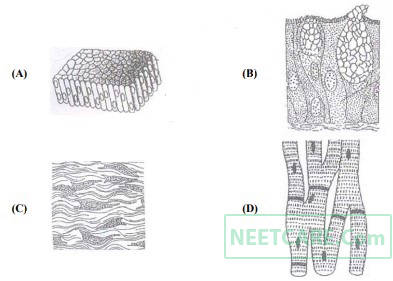
The four sketches (A, B, C and D) given below, represent four different types of animal tissues. Which one of these is correctly identified in the options given, along with its correct location and function ?
  • A.

    (A) Tissue \to Columnar epithelium, Location \to Nephron, Function \to Secretion and absorption

  • B.

    (C) Tissue \to Collagen fibres, Location \to Cartilage, Function \to Attach skeletal muscles to bones

  • C.

    (B) Tissue \to Glandular epithelium, Location \to Intestine, Function \to Secretion

  • D.

    (D) Tissue \to Smooth muscle tissue, Location \to Heart, Function \to Heart contraction

Answer: C
  1. We check each tissue-location-function combination against known facts about the tissue types shown.

  2. Option A is incorrect because the nephron's tubular parts are lined by cuboidal epithelium, not columnar epithelium.

  3. Option B is incorrect because collagen fibres are not exclusive to cartilage in this context, and their general function is to provide tensile strength, not to attach muscles to bones (that is the function of tendons).

  4. Option C is correct: glandular epithelium is found in locations like the intestine, where it performs secretion — for example, goblet cells secreting mucus.

  5. Option D is incorrect because the heart is made of cardiac muscle, not smooth muscle; smooth muscle is instead found in organs like the intestine and blood vessels.

  6. Since only option C correctly matches tissue, location, and function, it is the right answer.

Hence, the answer is C ((B) Glandular epithelium — Intestine — Secretion).
Q2

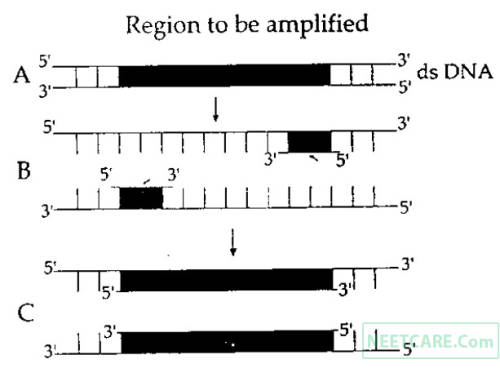
The figure below shows three steps (A, B, C) of Polymerase Chain Reaction (PCR). Select the option giving correct identification together with what it represents ?

  • A.

    C - Extension in the presence of heat stable DNA polymerase

  • B.

    B - Denaturation at a temperature of about 98ºC separating the two DNA strands

  • C.

    A - Denaturation at a temperature of about 50ºC

  • D.

    A - Annealing with two sets of primers

Answer: A
  1. Identifying step A — In the PCR cycle shown, step A represents denaturation, which occurs at a high temperature of about 9494^{\circ}98C98^{\circ}C, where the double-stranded DNA melts open into single strands and all enzymatic reactions stop.

  2. Identifying step B — Step B represents annealing, where DNA primers bind to the separated single strands, occurring at a lower temperature of about 5050^{\circ}65C65^{\circ}C.

  3. Identifying step C — Step C represents extension (elongation), where the primers are extended using a heat-stable DNA polymerase, most commonly Taq polymerase (from Thermus aquaticus), at around 72C72^{\circ}C.

  4. Matching to the correct option — Given this, only the description "C - Extension in the presence of heat stable DNA polymerase" correctly matches its step.

Hence, the answer is Option A.

Q3

In the five kingdom classification, Chlamydomonas and Chlorella have been included in

  • A.

    protista

  • B.

    algae

  • C.

    plantae

  • D.

    monera.

Answer: A
  1. Recall that Kingdom Protista, in Whittaker's five kingdom classification, includes all unicellular eukaryotic organisms.
Chlamydomonas,ChlorellaUnicellular, eukaryotic, photosynthetic\textit{Chlamydomonas}, \textit{Chlorella} \rightarrow \text{Unicellular, eukaryotic, photosynthetic}
  1. Since both Chlamydomonas and Chlorella are unicellular green algae with eukaryotic cell organization, they fit the definition of Protista rather than Plantae, which is reserved for multicellular organisms with specialized tissues.

Hence, the correct answer is Option A, protista.

Do more with a free account

  • Take it as a timed mock test
  • Build a daily streak
  • Track accuracy & progress
  • Save questions to your library