NEET 2013 (Karnataka) question paper with solutions

180 questions · 180 min

Practice the full NEET 2013 (Karnataka) paper free — every question with a detailed solution, graded instantly. Nothing is saved; log in to take it as a timed mock and track your progress.

Sample questions with solutions

Q1

Tissue culture technique can produce infinite number of new plants from a small parental tissue. The economic importance of the technique is in raising:

  • A.

    development of new species

  • B.

    genetically uniform population identical to the original parent

  • C.

    variants through picking up somaclonal variations

  • D.

    homozygous diploid plants

Answer: B
  1. Background: tissue culture (also called micropropagation) relies on the property of totipotency — the ability of a single plant cell to develop into a complete new plant.

  2. Because the new plants are grown vegetatively (without sexual reproduction) from cells of the same parent, all the resulting plants — collectively called a clone — are genetically identical to the parent plant.

  3. This genetically uniform reproduction is exactly what gives the technique its major economic value: farmers and industries can mass-produce plants that are guaranteed to have the same desirable traits as the original parent.

  4. This process does not aim to create new species, introduce variants (somaclonal variation is usually an unwanted side effect, not the goal), or specifically produce homozygous diploid plants.

  5. Hence, the correct answer is B: genetically uniform population identical to the original parent.
Q2

Inflorescence is racemose in

  • A.

    brinjal

  • B.

    tulip

  • C.

    aloe

  • D.

    soybean.

Answer: D
  1. Recall the definition of a racemose inflorescence.

In racemose (indefinite/indeterminate) inflorescence, the growth of the peduncle (main axis) is unlimited, the terminal bud does not convert into a flower, and flowers develop in acropetal succession (older flowers towards the base, younger ones towards the tip).

  1. Identify the flowering pattern in soybean.

Soybean belongs to family Fabaceae, which characteristically shows a racemose inflorescence pattern, matching the criteria above.

  1. Eliminate the other options.

Brinjal, tulip, and aloe do not show this same racemose pattern in the way soybean does among the given choices, based on the standard classification used here.

Hence, the answer is option D: soybean.

Q3

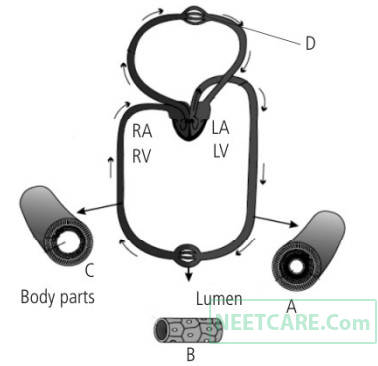
The figure shows blood circulation in humans with labels A to D. Select the option which gives correct identification of label and functions of the part.

  • A.

    A - Artery-Thick walled and blood flows evenly

  • B.

    C - Vein-Thin walled and blood flows in jerks/spurts

  • C.

    D - Pulmonary vein-Takes oxygenated blood to heart, pO2pO_2 = 95 mmHg

  • D.

    B - Capillary-Thin without muscle layer and wall two cell layers thick

Answer: C
  1. Checking option A: an artery does carry blood from the heart to body parts and is thick-walled, but blood flow inside it is actually intermittent (in pulses/jerks) rather than "even," so this description is incorrect.

  2. Checking option B: a vein does bring blood back toward the heart and is thin-walled, but its blood flow is generally steady/low-resistance, not in jerks or spurts (that's characteristic of arteries), so this description is incorrect.

  3. Checking option D: a capillary is indeed thin without a muscle layer, but its wall is actually only one cell layer thick (resting on a basement membrane), not two, so this description is incorrect.

  4. Checking option C: the pulmonary vein correctly carries oxygenated blood from the lungs back to the heart (specifically the left atrium), with a partial pressure of oxygen (pO2pO_2) around 95 mmHg — this description is accurate.

  5. Hence, the correct answer is C: D - Pulmonary vein-Takes oxygenated blood to heart, pO2pO_2 = 95 mmHg.

Do more with a free account

  • Take it as a timed mock test
  • Build a daily streak
  • Track accuracy & progress
  • Save questions to your library