Alcohol, Phenols and Ethers — NEET UG practice

54 questions

Practice NEET UG Alcohol, Phenols and Ethers questions free — each with a detailed solution, graded instantly. Nothing is saved; log in to track your accuracy and build a streak.

Sample questions with solutions

Q1 · 2026

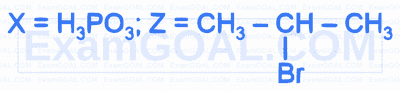
In the following reaction sequence, X and Z respectively are :

  • A.

  • B.

    X=POCl3;Z=CH3CH2CH2Br\mathrm{X}=\mathrm{POCl}_3 ; \mathrm{Z}=\mathrm{CH}_3 \mathrm{CH}_2 \mathrm{CH}_2-\mathrm{Br}

  • C.

  • D.

    X=H3PO3;Z=CH3CH2CH2Br\mathrm{X}=\mathrm{H}_3 \mathrm{PO}_3 ; \mathrm{Z}=\mathrm{CH}_3 \mathrm{CH}_2 \mathrm{CH}_2-\mathrm{Br}

Answer: B
  1. Look at the type of transformation happening in the sequence. The starting alcohol is being converted step by step into other functional groups, and reagent X is used at the very first step to replace an –OH group.

  2. Recall how alcohols react with phosphorus halides. Both PCl3\mathrm{PCl}_3 and PCl5\mathrm{PCl}_5 convert ROH\mathrm{R-OH} into RCl\mathrm{R-Cl}, but PCl5\mathrm{PCl}_5 additionally produces phosphorus oxychloride as a by-product:

ROH+PCl5RCl+HCl+POCl3\mathrm{R-OH} + \mathrm{PCl}_5 \rightarrow \mathrm{R-Cl} + \mathrm{HCl} + \mathrm{POCl}_3

Based on the steps shown in the sequence, the reagent X used corresponds to POCl3\mathrm{POCl}_3 acting as the chlorinating agent.

  1. Follow the later steps of the sequence, where the chloride intermediate is converted further until the final halogenated product Z is obtained.

Since the last step introduces a bromide in place of the earlier leaving group, the final product Z is the corresponding bromo-compound:

Z=CH3CH2CH2Br\mathrm{Z} = \mathrm{CH}_3\mathrm{CH}_2\mathrm{CH}_2-\mathrm{Br}
  1. Match with the given options. Only option B pairs X=POCl3\mathrm{X}=\mathrm{POCl}_3 with Z=CH3CH2CH2Br\mathrm{Z}=\mathrm{CH}_3\mathrm{CH}_2\mathrm{CH}_2-\mathrm{Br}, consistent with the reaction sequence.

Hence, the answer is option B.

Q2 · 2026

The functional group that can be identified through phthalein dye test is :

  • A.

    Aldehyde

  • B.

    Phenolic

  • C.

    Carboxylic acid

  • D.

    Alcohol

Answer: B
  1. Understand what the phthalein dye test checks for. This is a classic test used to confirm the presence of a phenolic –OH group in a compound.

  2. Recall the reaction involved. When phenol is heated with phthalic anhydride in the presence of concentrated sulphuric acid, a colourless condensation product is formed:

Phenol+Phthalic anhydrideconc. H2SO4Phenolphthalein (colourless)\text{Phenol} + \text{Phthalic anhydride} \xrightarrow{\text{conc. } \mathrm{H}_2\mathrm{SO}_4} \text{Phenolphthalein (colourless)}
  1. Note the confirmatory colour change. Phenolphthalein itself is colourless, but treating it with sodium hydroxide opens up its lactone ring and creates an extended conjugated system that absorbs visible light, turning it pink:
PhenolphthaleinNaOHPink coloured species\text{Phenolphthalein} \xrightarrow{\mathrm{NaOH}} \text{Pink coloured species}
  1. Connect this back to the functional group being tested. Only compounds bearing a phenolic –OH (an –OH directly attached to an aromatic ring) can undergo this specific condensation with phthalic anhydride, so a positive pink colour confirms the phenolic group, not an aldehyde, alcohol, or carboxylic acid.

Hence, the answer is option B.

Q3 · 2026

Arrange the following compounds in the increasing order of polarity

A. CH3CH2OCH2CH3\mathrm{CH}_3 \mathrm{CH}_2 \mathrm{OCH}_2 \mathrm{CH}_3

B. CH3CH2OH\mathrm{CH}_3 \mathrm{CH}_2 \mathrm{OH}

C. CH3COCH3\mathrm{CH}_3 \mathrm{COCH}_3

D. CH3COOH\mathrm{CH}_3 \mathrm{COOH}

Choose the correct answer from the options given below.

  • A.

    A<C<B<D\mathrm{A}<\mathrm{C}<\mathrm{B}<\mathrm{D}

  • B.

    A<B<C<D\mathrm{A}<\mathrm{B}<\mathrm{C}<\mathrm{D}

  • C.

    C<A<D<B\mathrm{C}<\mathrm{A}<\mathrm{D}<\mathrm{B}

  • D.

    C<A<B<D\mathrm{C}<\mathrm{A}<\mathrm{B}<\mathrm{D}

Answer: A
  1. Identify the functional group in each compound, since polarity mainly depends on the type of bond dipoles and hydrogen-bonding ability present.

Given the four compounds are an ether, a ketone, an alcohol and a carboxylic acid:

A=CH3CH2OCH2CH3 (ether),B=CH3CH2OH (alcohol)\mathrm{A} = \mathrm{CH}_3\mathrm{CH}_2\mathrm{OCH}_2\mathrm{CH}_3 \ \text{(ether)}, \quad \mathrm{B} = \mathrm{CH}_3\mathrm{CH}_2\mathrm{OH} \ \text{(alcohol)} C=CH3COCH3 (ketone),D=CH3COOH (carboxylic acid)\mathrm{C} = \mathrm{CH}_3\mathrm{COCH}_3 \ \text{(ketone)}, \quad \mathrm{D} = \mathrm{CH}_3\mathrm{COOH} \ \text{(carboxylic acid)}
  1. Compare the ether and the ketone. An ether has only a weak C–O–C dipole and cannot donate a hydrogen bond, while a ketone has a stronger, more polarized C=O dipole.

Therefore

A<C\mathrm{A} < \mathrm{C}
  1. Compare the ketone and the alcohol. An alcohol's –OH group can act as both a hydrogen bond donor and acceptor, which raises its overall polarity above that of a ketone (which can only accept, not donate, a hydrogen bond).

Hence

C<B\mathrm{C} < \mathrm{B}
  1. Compare the alcohol and the carboxylic acid. A carboxylic acid contains both a C=O and an –OH group in the same –COOH unit, giving it the strongest dipole and the most extensive hydrogen bonding (it even dimerizes through two hydrogen bonds).

So

B<D\mathrm{B} < \mathrm{D}
  1. Combine all the comparisons to get the complete order of increasing polarity:
A<C<B<D\mathrm{A} < \mathrm{C} < \mathrm{B} < \mathrm{D}

Hence, the answer is option A.

Do more with a free account

  • Take it as a timed mock test
  • Build a daily streak
  • Track accuracy & progress
  • Save questions to your library