Current Electricity — NEET UG practice

116 questions

Practice NEET UG Current Electricity questions free — each with a detailed solution, graded instantly. Nothing is saved; log in to track your accuracy and build a streak.

Sample questions with solutions

Q1 · 2026

In a metre bridge experiment (see figure), the positions of the cell, EE, and galvanometer, GG, are interchanged. We shall observe in the galvanometer:

  • A.

    Only the left-sided deflection

  • B.

    There will be no deflection irrespective of the position of the jockey

  • C.

    Only the right-sided deflection

  • D.

    Both right-sided and left-sided deflection and at balance point, no deflection

Answer: D
  1. Recall the balance condition of a metre bridge. A metre bridge is essentially a Wheatstone bridge, and its balance point depends only on the ratio of resistances in the four arms — not on which diagonal holds the cell and which holds the galvanometer.

  2. Apply this to swapping E and G. Since the resistance arms are unchanged, interchanging the cell and the galvanometer does not shift the position of the null (balance) point.

  3. Consider what happens away from the balance point. When the jockey is not at the balance point, swapping E and G changes the direction in which current is driven through the galvanometer branch, so the deflection may show up on either the left side or the right side of the balance point depending on the jockey's position.

  4. Consider what happens exactly at the balance point. At the true balance point, no current flows through the galvanometer branch at all, so there is no deflection there, regardless of the interchange.

  5. Putting this together: deflection can appear on both sides of the null point, but vanishes exactly at the balance point.

Hence, the answer is Option D.
Q2 · 2026

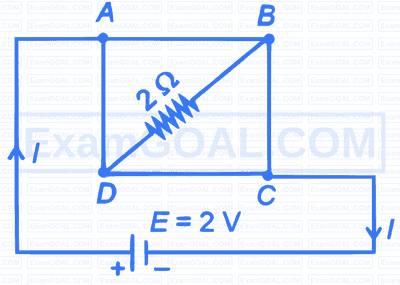
A uniform metallic wire having resistance 4Ω4 \Omega is bent to form a square loop (ABCD) (see figure). A resistance of 2Ω2 \Omega is connected between points BB and DD and a battery of 2 V is connected across points AA and CC as shown in the figure. Now the value of current (I)(I) is:

  • A.

    2 A

  • B.

    8 A

  • C.

    4.5 A

  • D.

    4 A

Answer: A
  1. Find the resistance of each side. Since the wire is uniform and its total resistance 4Ω4\,\Omega is spread over the 4 equal sides of the square, each side has
Rside=4Ω4=1ΩR_{side} = \frac{4\,\Omega}{4} = 1\,\Omega
  1. Recognize the bridge structure. With A and C connected to the battery, and B and D connected through a 2Ω2\,\Omega resistor, this is exactly a Wheatstone bridge, where the 2Ω2\,\Omega resistor plays the role of the galvanometer arm.

  2. Check the balance condition. A Wheatstone bridge is balanced when the ratio of resistances in adjacent arms is equal:

RABRAD=RBCRDC    11=11\frac{R_{AB}}{R_{AD}} = \frac{R_{BC}}{R_{DC}} \implies \frac{1}{1} = \frac{1}{1}

Since this holds, the bridge is balanced.

  1. Apply the balanced-bridge property. No current flows through the bridge arm (here, the 2Ω2\,\Omega resistor between B and D) when the bridge is balanced.

  2. Simplify the circuit. With no current through BD, the current only flows through two parallel paths: A→B→C (1+1=2Ω1+1=2\,\Omega) and A→D→C (1+1=2Ω1+1=2\,\Omega).

Reff=2×22+2=1ΩR_{eff} = \frac{2\times 2}{2+2} = 1\,\Omega
  1. Apply Ohm's law with the battery EMF of 2 V.
I=EReff=21=2 AI = \frac{E}{R_{eff}} = \frac{2}{1} = 2\text{ A}

Hence, the answer is Option A.

Q3 · 2026

A room heater is rated 400 W,220 V400\text{ W}, 220\text{ V}. If the supply voltage drops to 200 V, what will be the power consumed (approximately)?

  • A.

    200 W

  • B.

    400 W

  • C.

    331 W

  • D.

    121 W

Answer: C
  1. Find the resistance of the heater, which stays constant regardless of the applied voltage. Using P=V2RP=\dfrac{V^2}{R} with the rated values,
R=V12P1=2202400=121ΩR = \frac{V_1^2}{P_1} = \frac{220^2}{400} = 121\,\Omega
  1. Find the new power at the reduced voltage V2=200 VV_2=200\text{ V}, using the same resistance.
P2=V22R=2002121P_2 = \frac{V_2^2}{R} = \frac{200^2}{121}
  1. Simplify.
P2330.6 W331 WP_2 \approx 330.6\text{ W} \approx 331\text{ W}

Hence, the answer is Option C.

Do more with a free account

  • Take it as a timed mock test
  • Build a daily streak
  • Track accuracy & progress
  • Save questions to your library