Electrostatics — NEET UG practice

75 questions

Practice NEET UG Electrostatics questions free — each with a detailed solution, graded instantly. Nothing is saved; log in to track your accuracy and build a streak.

Sample questions with solutions

Q1 · 2026

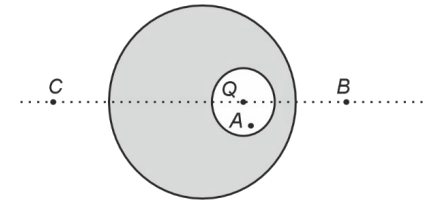
A point charge QQ is placed inside a cavity within a solid isolated conducting sphere. Consider points A,BA, B and CC as shown in the figure, where the magnitudes of the electric fields are EA,EB,ECE_A, E_B, E_C, respectively. The points BB and CC are at the same distance from the center of the solid sphere. The correct option is :
  • A.

    EA0,EB<ECE_A \neq 0, E_B< E_C

  • B.

    EA=0,EB=ECE_A=0, E_B=E_C

  • C.

    EA0,EB=ECE_A \neq 0, E_B=E_C

  • D.

    EA=0,EB>ECE_A=0, E_B>E_C

Answer: C
  1. Point AA lies inside the cavity where the point charge QQ is located, so there must be an electric field there to satisfy Gauss's law inside the cavity: EA0E_A\neq0

  2. Because the conductor is isolated and in electrostatic equilibrium, the induced charges rearrange themselves so that the charge on the outer surface distributes uniformly, regardless of where QQ sits inside the cavity. This is a consequence of electrostatic shielding.

  3. Once the outer surface charge is uniform, the field outside the conductor depends only on the distance from the centre, exactly like a point charge placed at the centre. Since BB and CC are at the same distance from the centre: EB=ECE_B=E_C

  4. Combining both results, EA0E_A\neq0 and EB=ECE_B=E_C.

Hence, the answer is option C.

Q2 · 2026

Which of the following statements are correct?

A. Inside a conductor, the electrostatic field is zero.

B. Electric field at the surface of a charged conductor does not depend on its surface charge density.

C. The interior of a charged conductor can have no excess charge in the static situation.

D. At the surface of a charged conductor, the electrostatic field must be normal to the surface at every point.

E. The electrostatic potential is zero everywhere inside a charged conductor.

Choose the correct answer from the options given below:

  • A.

    A, B and D only

  • B.

    A, C and E only

  • C.

    A, C and D only

  • D.

    C, D and E only

Answer: C
  1. Statement A: Inside a conductor in electrostatic equilibrium, free charges rearrange themselves so that the net electric field inside becomes zero. So statement A is true.

  2. Statement B: The electric field just outside the surface of a charged conductor is given by E=σε0n^E=\frac{\sigma}{\varepsilon_0}\hat{n} This clearly depends on the surface charge density σ\sigma, so statement B is false.

  3. Statement C: In the static situation, all excess charge on a conductor resides only on its outer surface; the interior has no excess charge. So statement C is true.

  4. Statement D: If the field at the surface had a component along the surface, charges would keep moving until equilibrium is reached, so in equilibrium the field must be normal to the surface at every point. Statement D is true.

  5. Statement E: Since the field inside a conductor is zero, the potential inside is constant, but this constant value need not be zero — it equals the potential of the surface. So statement E is false.

  6. The correct statements are A, C and D.

Hence, the answer is option C.

Q3 · 2026

A unit positive point charge is taken slowly through an infinitesimally thin tube that is inside a charged dielectric sphere of radius RR, having uniform positive charge density ρ\rho, as shown in the figure.

The initial and final positions of the charge are marked by AA and BB at distance 2R2R and 3R3R respectively, from the centre of the sphere. In this process, the magnitude of the total work done on the point charge is ρR2nε0\frac{\rho R^2}{n \varepsilon_0}. The value of nn is : ( ε0\varepsilon_0 is the permittivity of vacuum)

  • A.

    18

  • B.

    2

  • C.

    6

  • D.

    9

Answer: A
  1. Both points AA (at 2R2R) and BB (at 3R3R) lie outside the sphere (radius RR), so the sphere behaves like a point charge QQ placed at its centre when calculating the potential at these points. The potential outside a uniformly charged sphere is V(r)=14πε0QrV(r)=\frac{1}{4\pi\varepsilon_0}\frac{Q}{r}

  2. The total charge QQ of the sphere is found by multiplying the uniform charge density ρ\rho by the sphere's volume: Q=ρ×43πR3Q=\rho\times\frac{4}{3}\pi R^3

  3. Since the charge is moved slowly, all the work done by the external agent goes into changing potential energy, so the work done equals the (unit) charge times the potential difference between the final and initial points: W=q(VBVA)W=q(V_B-V_A)

  4. Substituting the potentials at r=3Rr=3R and r=2Rr=2R (with q=1q=1 for a unit charge): W=Q4πε0(13R12R)=Q4πε0R(16)W=\frac{Q}{4\pi\varepsilon_0}\left(\frac{1}{3R}-\frac{1}{2R}\right)=\frac{Q}{4\pi\varepsilon_0 R}\left(-\frac{1}{6}\right)

  5. Taking the magnitude and substituting Q=ρ×43πR3Q=\rho\times\frac{4}{3}\pi R^3: W=14πε0×1R×16×ρ×43πR3=ρR218ε0|W|=\frac{1}{4\pi\varepsilon_0}\times\frac{1}{R}\times\frac{1}{6}\times\rho\times\frac{4}{3}\pi R^3=\frac{\rho R^2}{18\varepsilon_0}

  6. Comparing this with the given expression ρR2nε0\frac{\rho R^2}{n\varepsilon_0}, we get n=18n=18.

Hence, the answer is option A.

Do more with a free account

  • Take it as a timed mock test
  • Build a daily streak
  • Track accuracy & progress
  • Save questions to your library