Gaseous State — NEET UG practice

33 questions

Practice NEET UG Gaseous State questions free — each with a detailed solution, graded instantly. Nothing is saved; log in to track your accuracy and build a streak.

Sample questions with solutions

Q1 · 2023

The correct option in which the density of argon (Atomic mass = 40) is highest:

  • A.

    STP

  • B.

    0°C, 2 atm

  • C.

    0°C, 4 atm

  • D.

    273°C, 4 atm

Answer: C
  1. Start from the ideal gas equation, since it relates pressure, volume, and temperature to the amount of gas:
PV=nRTPV=nRT
  1. Since the number of moles n=wMn=\frac{w}{M} (mass divided by molar mass), substitute this in:
PV=wMRTPV=\frac{w}{M}RT
  1. Rearranging to get an expression for density ρ=wV\rho=\frac{w}{V}:
ρ=PMRT\rho=\frac{PM}{RT}
  1. This tells us density is directly proportional to pressure and inversely proportional to temperature, since MM and RR are constants for a given gas.

So, to get the highest density, we need the option with the highest pressure and the lowest temperature.

  1. Compare all four options:
  • STP: T=273 KT=273\text{ K}, P=1 atmP=1\text{ atm}
  • 0°C, 2 atm: T=273 KT=273\text{ K}, P=2 atmP=2\text{ atm}
  • 0°C, 4 atm: T=273 KT=273\text{ K}, P=4 atmP=4\text{ atm}
  • 273°C, 4 atm: T=546 KT=546\text{ K}, P=4 atmP=4\text{ atm}
  1. Among these, 0°C, 4 atm has the highest pressure at the lowest possible temperature (273 K), since the last option has the same pressure but a much higher temperature (546 K), which lowers its density.

Hence, the answer is C.
Q2 · 2023

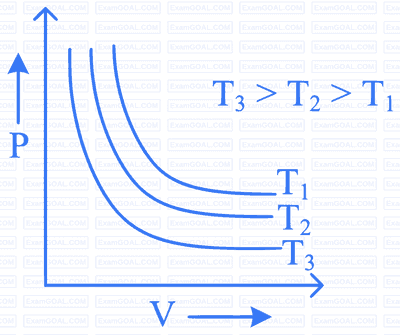
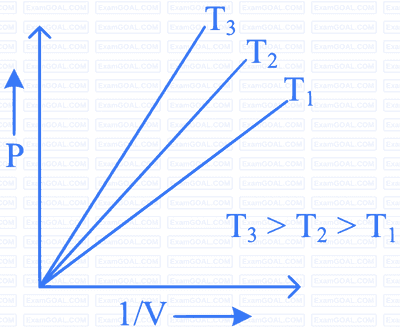
Which amongst the following options is correct graphical representation of Boyle's law?

  • A.

  • B.

  • C.

  • D.

Answer: A
  1. Recall Boyle's law: for a fixed amount of gas at constant temperature, pressure is inversely proportional to volume:
P1VP\propto\frac{1}{V}
  1. Using the ideal gas equation PV=nRTPV=nRT, we can write pressure as a function of 1V\frac{1}{V}:
P=(nRT)(1V)P=(nRT)\left(\frac{1}{V}\right)
  1. This is the equation of a straight line through the origin when PP is plotted against 1V\frac{1}{V}, where the slope equals nRTnRT.

  2. Since temperature TT appears in the slope, a higher temperature gives a steeper slope (a line rising more sharply).

Therefore, if a graph shows multiple straight lines for different temperatures T1T_1, T2T_2, T3T_3, the line with the greatest slope corresponds to the highest temperature:

T3>T2>T1T_3>T_2>T_1
  1. Option A correctly shows straight lines through the origin for PP vs 1V\frac{1}{V} with increasing slopes corresponding to increasing temperatures, matching Boyle's law.

Hence, the answer is A.

Q3 · 2023

The correct van der Waals equation for 1 mole of a real gas is :

  • A.

    (p+aV2)(Vb)=RT\left(p+\frac{a}{V^2}\right)(V-b)=RT

  • B.

    (p+V2a)(Vb)=RT\left(p+\frac{V^2}{a}\right)(V-b)=RT

  • C.

    (p+a2V2)(V2nb)=RT\left(p+\frac{a^2}{V^2}\right)\left(V^2-nb\right)=RT

  • D.

    (p+an2V)(Vnb)=nRT\left(p+\frac{an^2}{V}\right)(V-nb)=nRT

Answer: A
  1. Recall that an ideal gas is assumed to have point-sized molecules with no attraction between them, but a real gas does not behave this way.

Because real molecules occupy some space and attract each other, the ideal gas equation PV=RTPV=RT needs two corrections.

  1. Since real molecules have finite size, the volume actually available for movement is less than the measured volume VV.

So we subtract a correction term bb (called the excluded volume) from VV:

Vavailable=(Vb)V_{available}=(V-b)
  1. Since real molecules attract each other, the pressure they exert on the walls is slightly less than the ideal pressure.

Therefore a correction term aV2\frac{a}{V^2} is added to the observed pressure pp to make up for this loss:

pideal=(p+aV2)p_{ideal}=\left(p+\frac{a}{V^2}\right)
  1. Combining both corrections for 1 mole of gas gives the van der Waals equation:
(p+aV2)(Vb)=RT\left(p+\frac{a}{V^2}\right)(V-b)=RT
  1. Checking the options, only option A matches this exact form (with n=1n=1, so no nn appears).

Option B wrongly places V2V^2 in the numerator instead of the denominator; option C has the wrong exponent on aa and mismatched volume term; option D uses nn even though the equation is meant for 1 mole.

Hence, the answer is A.

Do more with a free account

  • Take it as a timed mock test
  • Build a daily streak
  • Track accuracy & progress
  • Save questions to your library