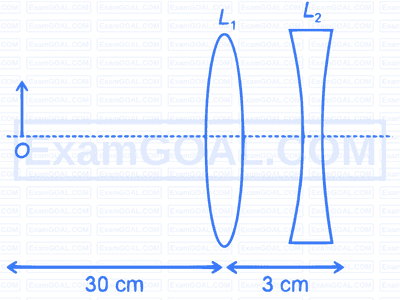
In a concave lens, a ray of light emanating from the object parallel to the principal axis of the lens after refraction:
- A.
passes through , which is the radius of curvature of the lens.
- B.
appears to diverge from the first principal focus.
- C.
emerges parallel to the principal axis.
- D.
passes through the second principal focus.
-
Recall how a concave lens bends parallel rays. A concave (diverging) lens spreads out any ray that travels parallel to the principal axis instead of converging it.
-
Trace the ray backward. After refraction, the outgoing ray diverges, but if we extend this diverging ray backward on the same side as the incoming ray, all such backward extensions appear to meet at a single point on the object side of the lens.
-
Identify this point. This point, from which the refracted ray appears to diverge, is the principal focus on the side of the incident ray.
-
Conclude the behaviour. So the ray does not actually pass through any focus (since it diverges), it only appears to diverge from a focal point.
Hence, the correct description is that the ray appears to diverge from the first principal focus, matching option B.