Haloalkanes and Haloarenes — NEET UG practice

38 questions

Practice NEET UG Haloalkanes and Haloarenes questions free — each with a detailed solution, graded instantly. Nothing is saved; log in to track your accuracy and build a streak.

Sample questions with solutions

Q1 · 2025

Given below are two statements: one is labelled as Assertion (A) and the other is labelled as Reason (R).

Assertion (A):

undergoes SN2S_N2 reaction faster than

Reason (R): Iodine is a better leaving group because of its large size.

In the light of the above statements, choose the correct answer from the options given below:

  • A.

    A is true but R is false

  • B.

    A is false but R is true

  • C.

    Both A and R are true and R is the correct explanation of A

  • D.

    Both A and R are true but R is not the correct explanation of A

Answer: C
  1. In an SN2S_N2 reaction, the incoming nucleophile attacks the carbon at the same time the leaving group departs, so anything that makes the leaving group leave more easily speeds up the whole reaction.

  2. As we go down a halogen family, the atomic size increases, so the carbon–halogen bond gets longer and weaker.

Given this trend,

Bond Strength: C-F>C-Cl>C-Br>C-IBond\ Strength:\ C\text{-}F > C\text{-}Cl > C\text{-}Br > C\text{-}I
  1. Since the C-IC\text{-}I bond is the weakest, it breaks most easily during the reaction.

  2. Also, the iodide ion formed, II^-, is very stable because its negative charge is spread over a large volume, so it does not mind leaving the carbon.

  3. Because of both the weak C-IC\text{-}I bond and the stability of II^-, the iodo-compound reacts faster in SN2S_N2 substitution than the corresponding chloro-compound. This confirms Assertion (A) is true.

  4. Reason (R) correctly explains this by pointing out that iodine's large size stabilises the leaving II^- ion, which is exactly why (A) happens.

Hence, both (A) and (R) are true and (R) correctly explains (A), so the answer is option C.
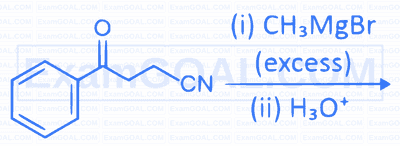
Q2 · 2025

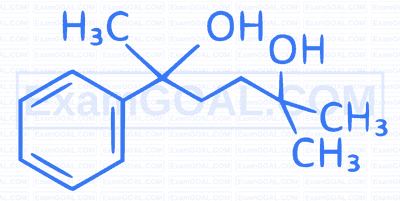
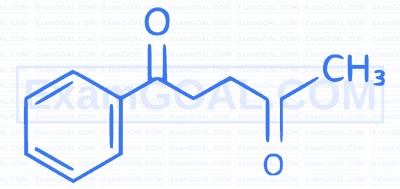
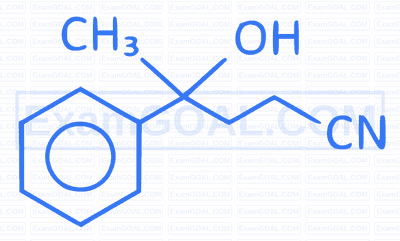
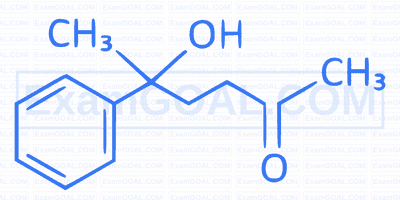
The major product of the following reaction is

  • A.

  • B.

  • C.

  • D.

Answer: D
  1. To find the major product of any organic reaction, first identify the type of reagent and mechanism it favours (substitution, elimination, or addition), since this decides which product forms preferentially.

  2. Next, check the substrate structure shown in the reaction — whether the reactive carbon is primary, secondary, or tertiary, because this affects whether SN1S_N1/E1E1 or SN2S_N2/E2E2 pathways dominate.

  3. Where a carbocation intermediate can form, the more stable (more substituted) carbocation is favoured, since a stable intermediate lowers the activation energy for that pathway.

  4. Applying this reasoning to the given scheme, the option that shows the product arising from the most stable intermediate and matching the regiochemistry of the reagent used is the correct major product.

  5. Comparing all four structures, option D matches the structure expected from this preferred pathway.

Hence, the major product is option D.

Q3 · 2024

The following reaction method

is not suitable for the preparation of the corresponding haloarene products, due to high reactivity of halogen, when X is:

  • A.

    F

  • B.

    I

  • C.

    Cl

  • D.

    Br

Answer: A
  1. Aryl halides are commonly made by electrophilic aromatic substitution, where the aromatic ring reacts with a halogen (X2X_2) in the presence of a Lewis acid catalyst such as FeFe.

  2. This method works smoothly for chlorine and bromine, since they are moderately reactive and give a controllable, largely irreversible substitution.

  3. Iodine reacts too slowly and reversibly, so an oxidising agent is needed to push the reaction forward, but the method can still be adapted.

  4. Fluorine, however, is extremely reactive and its reaction with arenes is highly exothermic and uncontrollable, often leading to decomposition of the ring rather than clean substitution.

  5. Because of this excessive reactivity, direct electrophilic fluorination of arenes is not a practical or suitable method to prepare fluoroarenes.

Hence, the halogen for which this method is unsuitable is F, so the answer is option A.

Do more with a free account

  • Take it as a timed mock test
  • Build a daily streak
  • Track accuracy & progress
  • Save questions to your library