P Block — NEET UG practice

93 questions

Practice NEET UG P Block questions free — each with a detailed solution, graded instantly. Nothing is saved; log in to track your accuracy and build a streak.

Sample questions with solutions

Q1 · 2026

The correct statement is

  • A.

    Aluminium has five valence orbitals.

  • B.

    Boron has a maximum covalency of four.

  • C.

    Beryllium has three valence orbitals.

  • D.

    Magnesium has a maximum covalency of four.

Answer: B
  1. Recall that the valence orbitals of an atom are all the orbitals in its outermost shell that are available for bonding; use this to check option A. Given aluminium (Al) has one 3s3s, three 3p3p, and five 3d3d orbitals available in its valence shell,
Total valence orbitals of Al=1(3s)+3(3p)+5(3d)=9\text{Total valence orbitals of Al} = 1(3s) + 3(3p) + 5(3d) = 9

So option A, which states five valence orbitals, is incorrect.

  1. Apply the same idea to beryllium, whose valence shell is the second shell containing only ss and pp orbitals.
Total valence orbitals of Be=1(2s)+3(2p)=4\text{Total valence orbitals of Be} = 1(2s) + 3(2p) = 4

Hence, option C is incorrect since beryllium actually has four valence orbitals, not three.

  1. Recall that maximum covalency depends on the number of orbitals an atom can use for bonding, including any accessible vacant dd-orbitals; check magnesium.
Maximum covalency of Mg=6\text{Maximum covalency of Mg} = 6

So option D is incorrect.

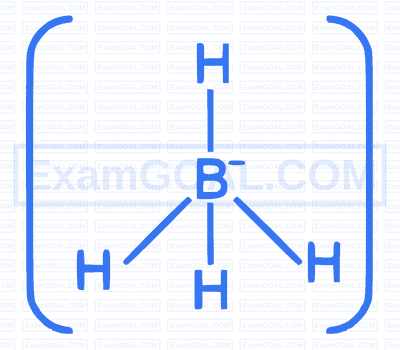
  1. For boron, since its valence shell (second shell) has no dd-orbitals, its maximum covalency is limited by the available 2s2s and 2p2p orbitals, allowing it to form up to four bonds (as seen in species like [BF4][\text{BF}_4]^-).
Maximum covalency of B=4\text{Maximum covalency of B} = 4

Hence, the answer is B.

Q2 · 2026

Identify the incorrect statement from the following:

  • A.

    Nitrogen can form pπpπp\pi-p\pi multiple bonds with itself.

  • B.

    P(C2H5)3\text{P(C}_2\text{H}_5)_3 and As(C6H5)3\text{As(C}_6\text{H}_5)_3 form dπdπd\pi-d\pi bond with transition metals.

  • C.

    Phosphorus, arsenic and antimony show catenation property.

  • D.

    Nitrogen can form dπpπd\pi-p\pi bond with oxygen.

Answer: D
  1. Recall that pπpπp\pi-p\pi bonding occurs between atoms of similar size that use their pp-orbitals to form multiple bonds; nitrogen is well known to do this with itself.
N(as in N2)\text{N} \equiv \text{N} \ (\text{as in N}_2)

So option A is a correct statement.

  1. Recall that elements with vacant dd-orbitals in their valence shell can accept electron density back-donated from transition metals, forming a dπdπd\pi-d\pi bond; phosphorus and arsenic both have accessible dd-orbitals. Given this, P(C2H5)3\text{P(C}_2\text{H}_5)_3 and As(C6H5)3\text{As(C}_6\text{H}_5)_3 can indeed form dπdπd\pi-d\pi bonds with transition metals, so option B is correct.

  2. Recall catenation is the ability of atoms of the same element to link together via bonds; among Group 15 elements, phosphorus, arsenic, and antimony all show this property. So option C is a correct statement.

  3. Check option D: forming a dπpπd\pi-p\pi bond requires at least one atom to contribute empty dd-orbitals. Since both nitrogen and oxygen belong to the second period,

Valence orbitals of N and O: 2s, 2p(no 3d available)\text{Valence orbitals of N and O: } 2s,\ 2p \quad (\text{no } 3d \text{ available})

neither atom has dd-orbitals to offer, so nitrogen cannot form a dπpπd\pi-p\pi bond with oxygen.

Hence, option D is the incorrect statement, so the answer is D.

Q3 · 2026

Identify the incorrect statement from the following:

  • A.

    Carbon has the ability to form pπpπp\pi-p\pi multiple bond with itself.

  • B.

    ECl3\text{ECl}_3 (E=B\text{E}=\text{B} and Al) is a monomer when E=B\text{E}=\text{B} and a dimer when E=Al\text{E}=\text{Al}.

  • C.

    The order of catenation property of Group 14 elements is CSi>GeSn\text{C} \gg \text{Si}>\text{Ge} \approx \text{Sn}.

  • D.

    Oxygen exhibits only 2-2 oxidation state.

Answer: D
  1. Recall that carbon can use its pp-orbitals to form pπpπp\pi-p\pi multiple bonds with itself, as seen in double and triple carbon-carbon bonds.
C=C,CC\text{C=C}, \quad \text{C}\equiv\text{C}

So option A is a correct statement.

  1. Recall that boron is small enough to complete its octet in BCl3\text{BCl}_3 using only three bonds (with some back-bonding), so it stays a monomer, whereas aluminium tends to complete its octet by forming a coordinate bond with another AlCl3\text{AlCl}_3 unit.
BCl3 (monomer),Al2Cl6 (dimer of AlCl3)\text{BCl}_3 \ (\text{monomer}), \quad \text{Al}_2\text{Cl}_6 \ (\text{dimer of AlCl}_3)

So option B is a correct statement.

  1. Recall that catenation strength in Group 14 decreases down the group as the element-element bond becomes weaker.
CSi>GeSn\text{C} \gg \text{Si} > \text{Ge} \approx \text{Sn}

So option C is a correct statement.

  1. Check option D: although oxygen commonly shows 2-2 in compounds like water, it also shows other oxidation states in different compounds.
O in O20,O in H2O21,O in H2O2\text{O in O}_2 \Rightarrow 0, \quad \text{O in H}_2\text{O}_2 \Rightarrow -1, \quad \text{O in H}_2\text{O} \Rightarrow -2

Since oxygen does not show only the 2-2 state, option D is the incorrect statement.

Hence, the answer is D.

Do more with a free account

  • Take it as a timed mock test
  • Build a daily streak
  • Track accuracy & progress
  • Save questions to your library