Rotational Motion — NEET UG practice

90 questions

Practice NEET UG Rotational Motion questions free — each with a detailed solution, graded instantly. Nothing is saved; log in to track your accuracy and build a streak.

Sample questions with solutions

Q1 · 2026

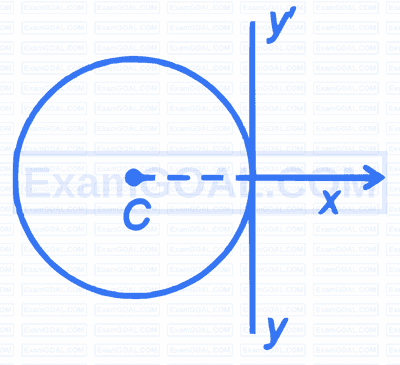
A thin wire of length 'LL' and linear mass density 'mm' is bent into a circular ring (in xx-yy plane) with centre 'CC' as shown in figure. The moment of inertia of the ring about an axis yyyy' will be:

  • A.

    3mL38π\frac{3mL^3}{8\pi}

  • B.

    3mL38π2\frac{3mL^3}{8\pi^2}

  • C.

    3mL28π\frac{3mL^2}{8\pi}

  • D.

    3mL28π2\frac{3mL^2}{8\pi^2}

Answer: B
  1. First find the mass of the wire using the definition of linear mass density (mass per unit length).
M=mLM = mL
  1. Since the wire of length LL is bent into a full circle, use the circumference formula to get the radius of the ring.
L=2πr    r=L2πL = 2\pi r \implies r = \frac{L}{2\pi}
  1. For a ring, the moment of inertia about a diameter (an axis in its own plane through the centre) is half that about the axis perpendicular to its plane.
Icm=12Mr2I_{cm} = \frac{1}{2}Mr^2
  1. The axis yyyy' shown is parallel to this diameter but shifted to the edge of the ring, so apply the parallel axis theorem to shift from the centre to the rim.
Iyy=Icm+Mr2=12Mr2+Mr2=32Mr2I_{yy'} = I_{cm} + Mr^2 = \frac{1}{2}Mr^2 + Mr^2 = \frac{3}{2}Mr^2
  1. Substituting M=mLM = mL and r=L2πr = \frac{L}{2\pi} gives the final answer in terms of mm and LL.
Iyy=32(mL)(L2π)2=3mL38π2I_{yy'} = \frac{3}{2}(mL)\left(\frac{L}{2\pi}\right)^2 = \frac{3mL^3}{8\pi^2}

Hence, the answer is option B.

Q2 · 2026

A thin horizontal disc is rotating about a vertical axis passing through its fixed centre OO. Its angular momentum is LAL_A and LBL_B computed about points AA and BB, respectively, with OB=2×OAOB=2\times OA. The value of LALB\frac{L_A}{L_B} is:

  • A.

    2

  • B.

    14\frac{1}{4}

  • C.

    12\frac{1}{2}

  • D.

    1

Answer: D
  1. Angular momentum about a point can always be split into two parts — the part due to the motion of the centre of mass about that point, plus the part due to rotation about the centre of mass.
L=r×P+Icmω\vec{L} = \vec{r} \times \vec{P} + I_{cm}\vec{\omega}
  1. Here the disc rotates about a fixed vertical axis through its centre OO, so the centre of mass never moves, meaning its linear momentum is zero.
P=0\vec{P} = 0
  1. Since P=0\vec{P}=0 holds for both points AA and BB, the first term vanishes in each case, leaving only the spin part, which does not depend on which point you measure it about.
LA=LB=Icmω\vec{L}_A = \vec{L}_B = I_{cm}\vec{\omega}
  1. Taking the ratio, the identical IcmωI_{cm}\vec{\omega} terms cancel out exactly.
LALB=1\frac{L_A}{L_B} = 1

Hence, the answer is option D.

Q3 · 2026

A solid sphere AA of radius RR and mass MM is attached at a point to a smaller solid sphere BB of radius r<Rr < R and mass m<Mm < M. Assume that the line joining their centres lies along the horizontal. The moment of inertia of the system calculated about a vertical axis passing through the centre of AA is IAI_A, and about the centre of BB is IBI_B. The difference IAIBI_A - I_B is:

  • A.

    0

  • B.

    (Mm)(R+r)2(M-m)(R+r)^2

  • C.

    (mM)(R+r)2(m-M)(R+r)^2

  • D.

    (mM)(Rr)2(m-M)(R-r)^2

Answer: C
  1. For a solid sphere, the moment of inertia about an axis through its own centre is given by the standard formula.
Icm=25mR2I_{cm} = \frac{2}{5}mR^2
  1. To find the moment of inertia of the whole system about the vertical axis through the centre of sphere AA, apply the parallel axis theorem to sphere BB, since its centre lies at a distance (R+r)(R+r) from this axis.
IA=25MR2+25mr2+m(R+r)2I_A = \frac{2}{5}MR^2 + \frac{2}{5}mr^2 + m(R+r)^2
  1. Similarly, to find the moment of inertia about the vertical axis through the centre of sphere BB, apply the parallel axis theorem to sphere AA instead, since now AA's centre lies at distance (R+r)(R+r) from this new axis.
IB=25MR2+M(R+r)2+25mr2I_B = \frac{2}{5}MR^2 + M(R+r)^2 + \frac{2}{5}mr^2
  1. Subtracting the two expressions, the common terms 25MR2\frac{2}{5}MR^2 and 25mr2\frac{2}{5}mr^2 cancel out, leaving only the extra parallel-axis terms.
IAIB=m(R+r)2M(R+r)2=(mM)(R+r)2I_A - I_B = m(R+r)^2 - M(R+r)^2 = (m-M)(R+r)^2

Hence, the answer is option C.

Do more with a free account

  • Take it as a timed mock test
  • Build a daily streak
  • Track accuracy & progress
  • Save questions to your library