Semiconductor Electronics — NEET UG practice

119 questions

Practice NEET UG Semiconductor Electronics questions free — each with a detailed solution, graded instantly. Nothing is saved; log in to track your accuracy and build a streak.

Sample questions with solutions

Q1 · 2026

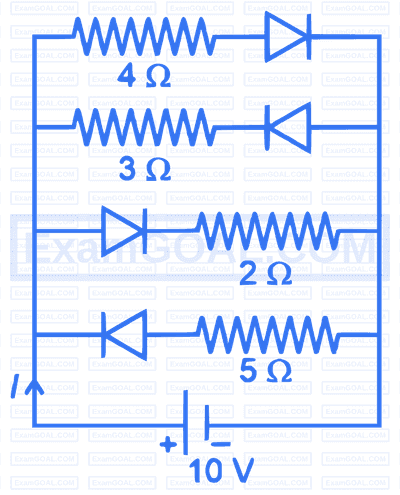
The current II in the circuit shown below is: (All diodes are ideal and identical)
  • A.

    53\frac{5}{3} A

  • B.

    59\frac{5}{9} A

  • C.

    13\frac{1}{3} A

  • D.

    152\frac{15}{2} A

Answer: D
  1. Recall how an ideal diode behaves in a circuit.

An ideal diode offers zero resistance when forward biased (acts like a plain wire) and infinite resistance when reverse biased (acts like an open circuit, blocking all current through that branch).

  1. Simplify the given circuit using this rule.

By checking the polarity of the battery relative to each diode, the forward-biased diodes are replaced by simple wires (their resistance branches remain), while any reverse-biased diode branch is removed as an open circuit. Given the figure, this redraws the circuit into two parallel resistive branches of 2 Ω2\ \Omega and 4 Ω4\ \Omega, both connected across the same 1010 V source.

  1. Use Ohm's Law to find the current through each simplified branch.

Since each branch independently sees the full 1010 V:

I1=102,I2=104I_1 = \frac{10}{2}, \quad I_2 = \frac{10}{4}
  1. Add the branch currents to get the total current supplied by the battery, since the branches are in parallel.

Therefore:

I=102+104=304=152 AI = \frac{10}{2} + \frac{10}{4} = \frac{30}{4} = \frac{15}{2}\text{ A}

Hence, the current II is 152\frac{15}{2} A, which is option D.

Q2 · 2026

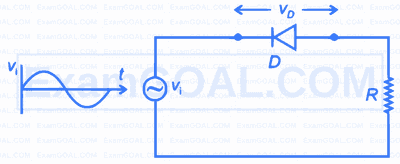
In the circuit shown below, the voltage appearing across the diode DD will be of the form:

  • A.

  • B.

  • C.

  • D.

Answer: D
  1. Recall how an ideal diode responds to an AC input signal.

An ideal diode conducts (behaves like a wire, zero voltage drop) only when it is forward biased, and blocks current (behaves like an open switch) when it is reverse biased. When the diode is reverse biased and blocking, the entire input voltage appears across the diode itself rather than across the rest of the circuit.

  1. Analyse the diode's bias state during each half of the input cycle.

Given the circuit orientation, during the positive half cycle the diode DD becomes reverse biased, so no current flows and the diode blocks the circuit. Since the diode is reverse biased, the full input voltage waveform appears across it during this half.

  1. Analyse the other half of the cycle.

During the negative half cycle, the diode becomes forward biased and conducts like a plain wire, so the voltage across the diode drops to nearly 00 V for that half.

  1. Combine both halves to get the overall voltage waveform across the diode.

Therefore, the voltage across the diode follows the input waveform only during the positive half (when reverse biased) and stays at zero during the negative half (when forward biased and conducting).

Hence, this matches the waveform shown in option D.

Q3 · 2026

Two statements are given below:

A. When the forward bias voltage across a p-n junction diode increases above a certain threshold voltage, the diode current increases significantly.

B. This current is called reverse saturation current.

Choose the correct answer from the options given below:

  • A.

    Both Statements A and B are true

  • B.

    Statement A is true, but Statement B is false

  • C.

    Both Statements A and B are false

  • D.

    Statement A is false, but Statement B is true

Answer: B
  1. Recall the shape of the V-I characteristic of a forward-biased p-n junction diode.

As the forward voltage is increased, very little current flows initially. But once the voltage crosses a certain threshold (knee) voltage, the current rises sharply and significantly. This directly matches what Statement A describes, so Statement A is true.

  1. Recall what reverse saturation current actually refers to.

Reverse saturation current is a small, nearly constant current that flows when a diode is reverse biased, caused by minority charge carriers, and it does not increase sharply with voltage the way forward current does.

  1. Compare this definition with what Statement B claims.

Given that Statement B calls the sharply increasing forward current "reverse saturation current," this is incorrect, since reverse saturation current belongs to the reverse-bias condition, not the forward-bias condition described in Statement A. So Statement B is false.

Hence, Statement A is true and Statement B is false, which corresponds to option B.

Do more with a free account

  • Take it as a timed mock test
  • Build a daily streak
  • Track accuracy & progress
  • Save questions to your library