Structure of Atom — NEET UG practice

60 questions

Practice NEET UG Structure of Atom questions free — each with a detailed solution, graded instantly. Nothing is saved; log in to track your accuracy and build a streak.

Sample questions with solutions

Q1 · 2026

Match List I with List II :

List I (n)List I (l)List II (Orbital)
A.21I.3d
B.40II.2p
C.53III.4s
D.32IV.5f

Choose the correct answer from the options given below.

  • A.

    A-IV, B-II, C-III, D-I

  • B.

    A-II, B-III, C-I, D-IV

  • C.

    A-II, B-III, C-IV, D-I

  • D.

    A-I, B-II, C-III, D-IV

Answer: C
  1. The principal quantum number (nn) gives the shell number and appears as the first digit of the orbital name, while the azimuthal quantum number (ll) decides the subshell letter using the code:
l=0s,l=1p,l=2d,l=3fl=0 \to s,\quad l=1 \to p,\quad l=2 \to d,\quad l=3 \to f
  1. For entry A, n=2n=2 and l=1l=1, so combining these values gives the orbital
2p2p

This matches II.

  1. For entry B, n=4n=4 and l=0l=0, so the orbital is
4s4s

This matches III.

  1. For entry C, n=5n=5 and l=3l=3, so the orbital is
5f5f

This matches IV.

  1. For entry D, n=3n=3 and l=2l=2, so the orbital is
3d3d

This matches I.

Hence, the correct matching is A-II, B-III, C-IV, D-I, so the answer is C.
Q2 · 2026

A bulb is rated at 150 watt, converting 8%8\% energy into light. If energy of one photon is 4.42×10194.42 \times 10^{-19} J, how many photons are emitted by the bulb per second?

  • A.

    2.71×10192.71 \times 10^{19}

  • B.

    4.06×10194.06 \times 10^{19}

  • C.

    27.2×101927.2 \times 10^{19}

  • D.

    1.35×10191.35 \times 10^{19}

Answer: A
  1. Since power is energy delivered per second, the total energy radiated by the bulb in one second equals its power rating.
Etotal=150×1=150 JE_{total} = 150 \times 1 = 150\ \text{J}
  1. Only 8%8\% of this total energy is converted into light, so the light energy produced per second is
Elight=150×8100=12 JE_{light} = \frac{150 \times 8}{100} = 12\ \text{J}
  1. Since the total light energy equals the number of photons multiplied by the energy of a single photon,
Elight=n×EphotonE_{light} = n \times E_{photon}

Therefore, solving for nn,

n=124.42×10192.71×1019n = \frac{12}{4.42 \times 10^{-19}} \approx 2.71 \times 10^{19}

Hence, the answer is A.

Q3 · 2026

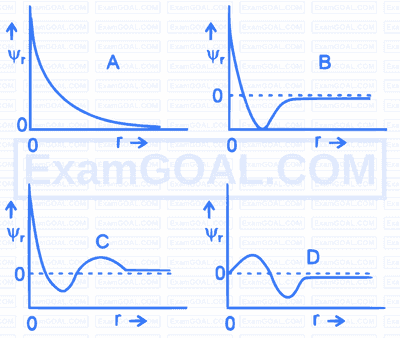
Consider the following schematic plots of orbital wavefunction (ψr)(\psi_r) against distance (r)(r) from the nucleus.

The figure representing two radial nodes in the orbital is

  • A.

    D

  • B.

    A

  • C.

    B

  • D.

    C

Answer: D
  1. Radial nodes are the points (other than r=0r=0 and r=r=\infty) where the radial wavefunction ψr\psi_r becomes zero, so the curve crosses the rr-axis at each radial node.

Given the formula that connects radial nodes to the quantum numbers,

Number of radial nodes=nl1\text{Number of radial nodes} = n - l - 1
  1. Therefore, an orbital having exactly two radial nodes must satisfy
nl1=2n - l - 1 = 2
  1. Among the four schematic plots, the correct one is the curve that crosses the rr-axis exactly twice before finally decaying to zero at large rr, since each crossing represents one radial node.

Hence, the plot satisfying this condition corresponds to option D (whose content is figure "C"), so the answer is D.

Do more with a free account

  • Take it as a timed mock test
  • Build a daily streak
  • Track accuracy & progress
  • Save questions to your library