Hydrocarbons — NEET UG practice

70 questions

Practice NEET UG Hydrocarbons questions free — each with a detailed solution, graded instantly. Nothing is saved; log in to track your accuracy and build a streak.

Sample questions with solutions

Q1 · 2026

The number of chlorine atoms present in the organic products XX and YY of the following reactions, respectively, are :

  • A.

    3 and 3

  • B.

    6 and 3

  • C.

    6 and 6

  • D.

    3 and 6

Answer: C
  1. Identify the two types of reaction an aromatic ring can undergo with Cl₂ — depending on the conditions, chlorine either substitutes a hydrogen (electrophilic substitution, needs a Lewis acid catalyst like FeCl₃) or adds across the ring (free-radical addition, needs sunlight/UV light, no catalyst).

  2. Analyse the condition used to form product X. Given that the reaction proceeds under sunlight/UV light, three molecules of Cl₂ add across the three double bonds of the aromatic ring:

C6H6+3Cl2hνC6H6Cl6C_6H_6 + 3Cl_2 \xrightarrow{h\nu} C_6H_6Cl_6

This product, benzene hexachloride (BHC), contains 6 chlorine atoms.

  1. Analyse the condition used to form product Y. Given that this reaction is also carried out under UV light/sunlight conditions rather than with a halogen-carrier catalyst, the same free-radical addition pathway operates, again adding three Cl₂ units and giving 6 chlorine atoms in the product.

  2. Conclusion: Both X and Y are addition products bearing 6 chlorine atoms each. Hence, the answer is Option C.

Q2 · 2026

Given below are two statements :

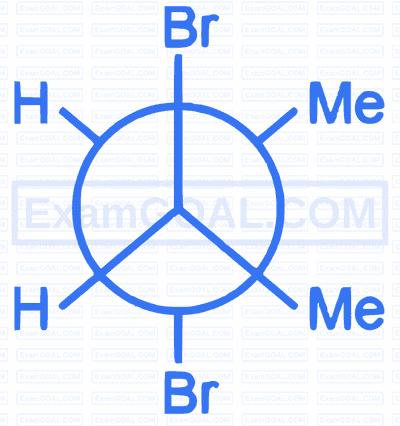
Statement I : trans-But-2-ene upon treatment with Br2\mathrm{Br}_2 in CCl4\mathrm{CCl}_4 gives the following product.

Statement II : cis-But-2-ene upon treatment with alkaline KMnO4\mathrm{KMnO}_4 gives the following product.

In the light of the above statements, choose the most appropriate answer from the options given below.

  • A.

    Statement I is incorrect but Statement II is correct

  • B.

    Both Statement I and Statement II are correct

  • C.

    Both Statement I and Statement II are incorrect

  • D.

    Statement I is correct but Statement II is incorrect

Answer: A
  1. Recall the addition mechanism of Br₂/CCl₄ — bromination of an alkene proceeds through a cyclic bromonium ion, which forces the two bromine atoms to add from opposite faces of the double bond (anti-addition).

  2. Apply anti-addition to trans-2-butene. Given a trans alkene undergoing anti-addition, the product formed is the d,l (racemic) pair of 2,3-dibromobutane, not the meso form.

trans-but-2-ene+Br2CCl4(2R,3R)- and (2S,3S)-2,3-dibromobutane (d,l pair)\text{trans-but-2-ene} + \mathrm{Br}_2 \xrightarrow{\mathrm{CCl}_4} (2R,3R)\text{- and } (2S,3S)\text{-2,3-dibromobutane (d,l pair)}

Since the structure shown in Statement I is the meso diastereomer, it does not match the actual product. Hence, Statement I is incorrect.

  1. Recall the mechanism of cold alkaline KMnO₄ addition — this reagent adds two –OH groups on the same face of the double bond through a cyclic manganate ester intermediate (syn-addition), known as the Baeyer test/dihydroxylation.

  2. Apply syn-addition to cis-2-butene. Given a cis alkene undergoing syn-addition, the two new –OH groups end up on the same side, giving the meso diol.

cis-but-2-enealkalineKMnO4meso-butane-2,3-diol\text{cis-but-2-ene} \xrightarrow[\text{alkaline}]{\mathrm{KMnO}_4} \textit{meso}\text{-butane-2,3-diol}

This matches the product drawn in Statement II, so Statement II is correct.

  1. Conclusion: Statement I is incorrect while Statement II is correct. Hence, the answer is Option A.
Q3 · 2026

Among the following, the compound having conjugated double bonds is

  • A.

    hepta-1,6-diene

  • B.

    hepta-1,3-diene

  • C.

    hepta-1,4-diene

  • D.

    hepta-1,5-diene

Answer: B
  1. Understand what 'conjugated' means — a conjugated diene is one in which two C=C double bonds are separated by exactly one single bond, allowing the π-electron clouds to overlap (e.g. C=C–C=C).

  2. Check each option for the position of the double bonds. Given hepta-1,6-diene, the double bonds are at C1–C2 and C6–C7 — separated by four single bonds, so this is an isolated diene.

  3. Given hepta-1,3-diene, the double bonds are at C1–C2 and C3–C4:

CH2=CHCH=CHCH2CH2CH3CH_2=CH-CH=CH-CH_2-CH_2-CH_3

Here, the double bonds are separated by only one single bond (C2–C3), which is the defining feature of conjugation.

  1. Given hepta-1,4-diene and hepta-1,5-diene, the double bonds are separated by two and three single bonds respectively — both are isolated (non-conjugated) dienes.

  2. Conclusion: Only hepta-1,3-diene has its double bonds separated by a single bond. Hence, the answer is Option B.

Do more with a free account

  • Take it as a timed mock test
  • Build a daily streak
  • Track accuracy & progress
  • Save questions to your library